

Why Many Businesses Struggle to Grow
Many businesses work hard every day but still feel stuck. Production delays continue, orders move slowly, and teams remain busy but results do not improve.
The real problem is often simple: a single weak point is slowing the entire system. This is exactly what the Theory of Constraints helps businesses understand.
The Theory of Constraints is a management approach that focuses on identifying the biggest limitation inside a process and improving it.
Understanding the Idea Behind the Theory
Every business system has at least one constraint. It could be a machine, a policy, or even a skill shortage. According to the Theory of Constraints, the overall performance of a system is limited by its weakest point.
For example, in a production line:
- One slow machine can delay the entire process
- One overloaded employee can slow down decision-making
- One inefficient process can delay deliveries
The Theory of Constraints teaches leaders to focus on the bottleneck instead of spreading improvement efforts everywhere.
Why Finding the Constraint Matters
Many companies try to improve multiple areas at the same time. They invest in new tools, training, or systems but still see limited improvement.
This happens because the real constraint remains untouched.
The Theory of Constraints helps businesses focus their efforts on what truly limits growth.
When the constraint improves:
- Productivity increases
- Delays reduce
- Costs become more controlled
- Customer satisfaction improves
The Five Steps of the Theory of Constraints
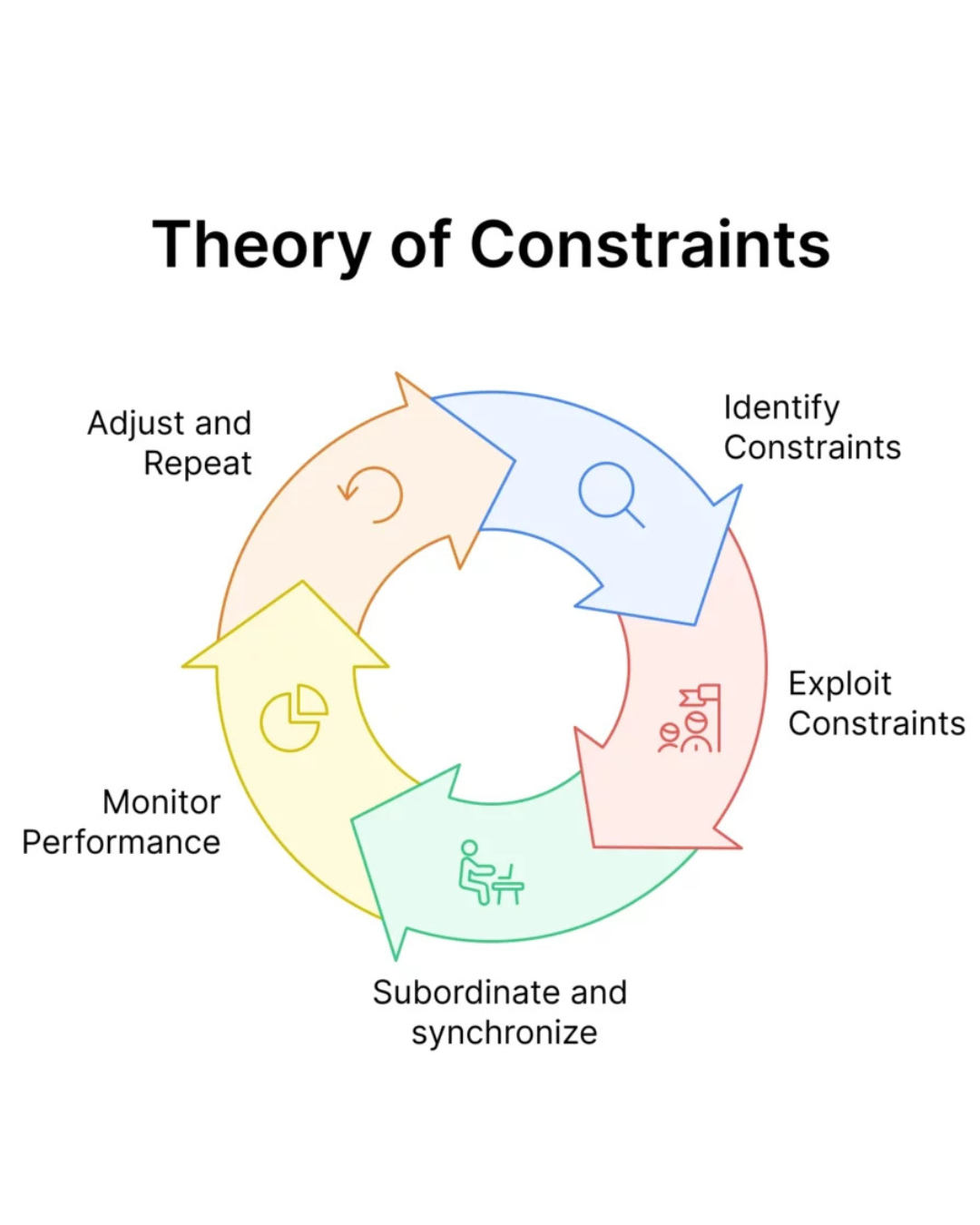
The Theory of Constraints follows a clear five-step improvement process.
1. Identify the Constraint
Find the biggest bottleneck that is slowing down the system.
This could be a machine, department, or decision process.
2. Exploit the Constraint
Make sure the constraint is used as efficiently as possible.
For example:
- Reduce downtime
- Prioritize important tasks
- Avoid unnecessary interruptions
3. Subordinate Other Processes
Align all other activities to support the constraint.
If other departments work faster than the constraint, it only creates more backlog.
4. Elevate the Constraint
If the bottleneck still limits performance, invest in improvements such as:
- Additional capacity
- Better equipment
- Additional staff
5. Repeat the Process
Once the constraint improves, another constraint may appear.
The Theory of Constraints encourages continuous improvement by identifying the next limitation.
A Simple Business Example
Imagine a small manufacturing company producing packaged goods. The company has five stages in production, but packaging is slower than all other processes. Finished products wait in large quantities before packaging.
In this case, packaging is the constraint.
Using the Theory of Constraints, the business can:
- Increase packaging efficiency
- Add an additional packaging line
- Improve workflow around the packaging stage
Benefits for Indian MSMEs
For Indian MSMEs, resources are often limited. Businesses cannot afford to improve everything at the same time. This is why the Theory of Constraints is extremely useful.
It helps business owners:
- Focus on the most important operational problem
- Use resources more efficiently
- Improve productivity without large investments
- Reduce delays and operational confusion
The Role of Leadership
Successful implementation requires leadership awareness.
Leaders must regularly ask an important question:
What is currently limiting our growth?
When leaders understand the principles of the Theory of Constraints, they stop spreading efforts across too many areas.
Instead, they focus on solving the most critical problem first. This disciplined thinking leads to stronger decision-making and better operational control.
Conclusion
Many businesses try to grow by improving multiple areas at once. Unfortunately, this approach often wastes time and resources.
The Theory of Constraints offers a smarter path. By identifying the single biggest bottleneck and improving it, organizations can unlock significant performance gains.
For business owners, the lesson is simple.
Every system has a limitation.
Success comes from identifying it, improving it, and repeating the process.
Image Credits: SixSigma
For more articles on startup growth, fundraising strategies, and business insights for Indian founders,
visit: Udyamee India Magazine