

A practical guide to understanding how Six Thinking Hats helps teams think clearly, reduce conflict, and make smarter business decisions.
What Is Six Thinking Hats?
Six Thinking Hats is a structured thinking method used to improve decision-making and group discussions in organizations.
In many meetings, people argue from different viewpoints at the same time. Some focus on risks, some talk about benefits, and others react emotionally. This creates confusion and delays.
Six Thinking Hats solves this problem by separating different types of thinking into clear categories. Instead of debating randomly, the entire team focuses on one type of thinking at a time.
This makes discussions more organized and productive.
Why Businesses Need Structured Thinking
For Indian MSMEs, startups, and growing companies, decision-making speed and clarity are critical. Poor decisions can lead to financial losses, operational delays, and internal conflicts.
Using Six Thinking Hats helps teams:
- Avoid unproductive arguments
- Encourage balanced participation
- Look at decisions from multiple angles
- Reduce emotional bias
- Improve meeting efficiency
It turns scattered discussions into structured conversations.
The Core Principle Behind the Method
The main idea behind Six Thinking Hats is simple:
Everyone thinks in the same direction at the same time.
Instead of one person being negative and another being overly optimistic during the same discussion, the team moves step by step through different thinking modes.
This creates clarity and reduces personal conflict.
Understanding the Six Hats
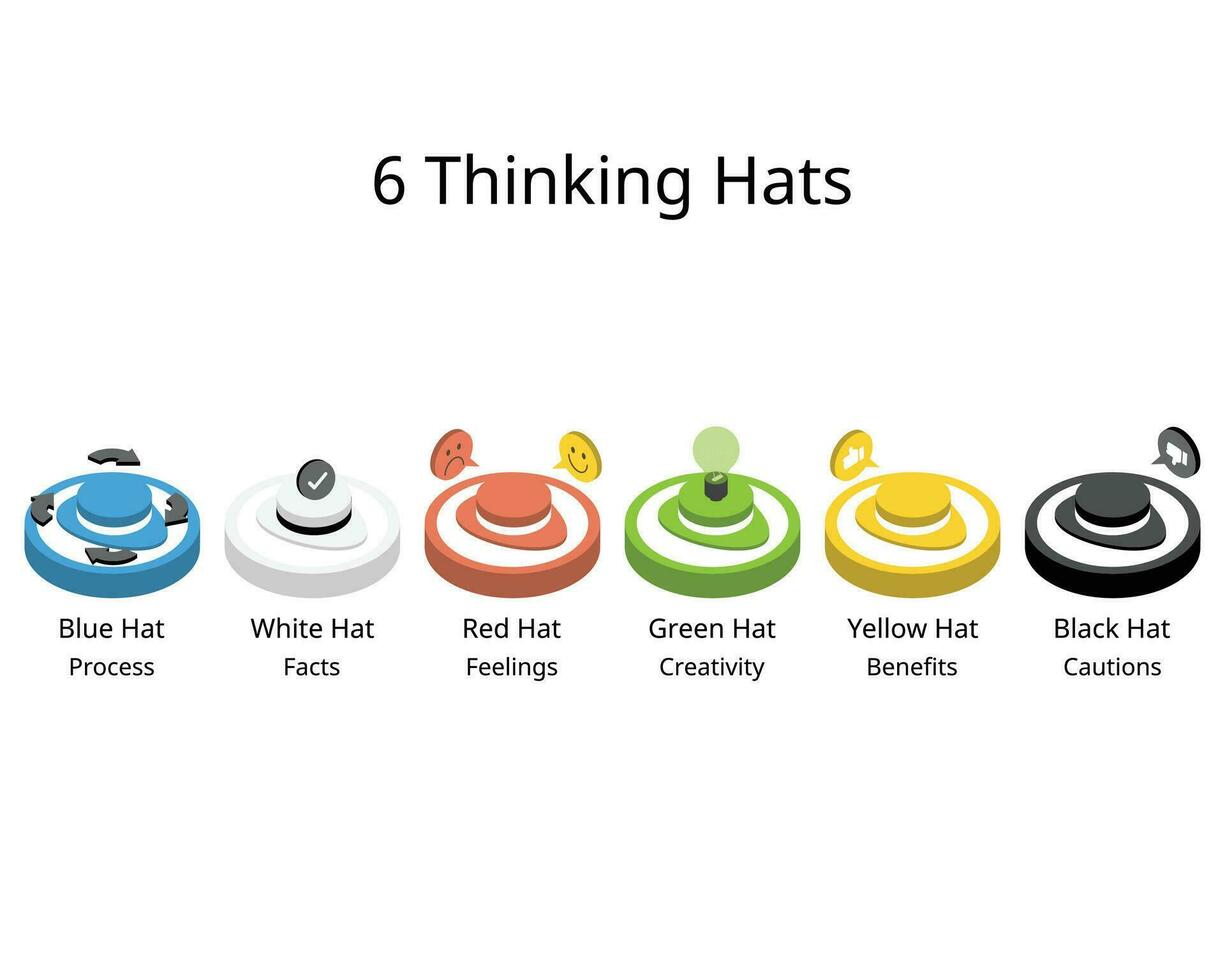
Each “hat” represents a different way of thinking.
1. White Hat, Facts and Information
This hat focuses only on data.
- What information do we have?
- What facts are available?
- What data is missing?
There are no opinions here, only objective information.
2. Red Hat, Feelings and Intuition
This hat allows emotional reactions.
- What is your gut feeling?
- Do you feel confident or concerned?
Participants do not need to justify their emotions. This helps surface hidden concerns.
3. Black Hat, Risks and Caution
This hat looks at possible problems.
- What could go wrong?
- What are the risks?
- What are the weaknesses?
This prevents costly mistakes and unrealistic optimism.
4. Yellow Hat, Benefits and Value
This hat focuses on positives.
- What are the advantages?
- Why might this succeed?
- What value does it create?
It ensures opportunities are not ignored.
5. Green Hat, Creativity and Alternatives
This hat encourages new ideas.
- Is there a better approach?
- Can we modify the plan?
- What innovative solutions exist?
Creativity becomes structured instead of random.
6. Blue Hat, Process Control
This hat manages the discussion.
- What is our objective?
- What step are we on?
- What decision have we reached?
The Blue Hat ensures discipline and direction.
Practical Example: Business Expansion Decision
Imagine a manufacturing company planning to expand into a new city.
Using Six Thinking Hats, the discussion can follow this structure:
- White Hat: Review market data, costs, and competitor presence.
- Red Hat: Capture management’s confidence or concerns.
- Black Hat: Identify financial and operational risks.
- Yellow Hat: Discuss growth potential and brand visibility.
- Green Hat: Explore alternative expansion models.
- Blue Hat: Summarize and finalize next steps.
This structured approach leads to a balanced and confident decision.
Benefits of Using This Method
When applied properly, Six Thinking Hats provides:
- Clear and organized meetings
- Reduced emotional conflict
- Better risk assessment
- Stronger strategic thinking
- Faster decision-making
It improves both leadership effectiveness and team collaboration.
Most importantly, it separates ego from discussion. The focus remains on the issue,not the individual.
When Should You Use It?
This method works especially well when:
- Making strategic decisions
- Planning new projects
- Launching products
- Solving complex problems
- Conducting leadership meetings
- Managing disagreements
Whenever discussions become confusing or emotional, Six Thinking Hats can bring structure.
Common Mistakes to Avoid
Some organizations reduce effectiveness by:
- Mixing different hats at the same time
- Skipping certain perspectives
- Rushing through the steps
- Not assigning someone to manage the process
The method works best when followed step by step with discipline.
How It Supports Growth and Quality Systems
Structured thinking improves risk awareness and planning quality. It aligns well with ISO-based management systems and risk-based thinking.
Six Thinking Hats encourages balanced evaluation before action is taken. This reduces impulsive decisions and strengthens long-term planning.
For growing businesses, clarity in thinking directly impacts profitability and sustainability.
Conclusion
Six Thinking Hats is a smart and practical decision-making framework that transforms the way teams think and discuss.
In today’s competitive business environment, unclear meetings and emotional debates can slow growth. Six Thinking Hats provides structure, clarity, and confidence in leadership decisions.
It does not replace experience or expertise, it organizes them.
Businesses that adopt Six Thinking Hats consistently build stronger strategies, better teamwork, and sustainable growth.
Image Credits: Vecteezy
For more articles on startup growth, fundraising strategies, and business insights for Indian founders,
visit: Udyamee India Magazine