

Close Menu
udyamee
  • Home
  • Growth
    • Strategy
    • Leadership
    • Marketing
    • Operations
    • Sales
  • Innovation
    • Tech
    • AI
    • Automation
    • Digital tools
  • Startups
    • Funding
    • Planning
    • Branding
    • Success stories
  • Finance
    • Money
    • Investors
    • Tax
    • Planning
  • Events
    • Awards
    • Summits
    • Networking
  • Spotlight
    • Featured founder
    • Influencer
    • Brand
  • HR & People
    • Hiring
    • Culture
    • Productivity
    • Workplace
  • Udyamee Initiative
    • Udyamee Business Council
    • Udyamee Awards
  • My Account
What's Hot

Just-in-Time (JIT): The Smart Inventory Strategy That Reduces Waste and Increases Profit

February 20, 2026

Six Thinking Hats: The Powerful Thinking Method That Transforms Business Decision-Making

February 19, 2026

Fishbone Diagram: Stop Guessing and Finally See What’s Really Causing Your Problems

February 18, 2026
Facebook X (Twitter) Instagram Threads
Trending
  • Just-in-Time (JIT): The Smart Inventory Strategy That Reduces Waste and Increases Profit
  • Six Thinking Hats: The Powerful Thinking Method That Transforms Business Decision-Making
  • Fishbone Diagram: Stop Guessing and Finally See What’s Really Causing Your Problems
  • Five Whys Analysis: The Proven Secret That Finally Stops Your Business Problems for Good
  • Root Cause Solutions: Stop Wasting Time on Problems That Keep Coming Back
  • FMEA: The Risk Tool That Stops Problems Before They Cost You Money
  • Process Clarity Unlocked: The Simple Tool That Transforms How Your Business Works
  • Kaizen: Small Steps, Big Results, how Continuous Improvement Transforms Your Business
udyamee
My Account
  • Home
  • Growth
    • Strategy
    • Leadership
    • Marketing
    • Operations
    • Sales
  • Innovation
    • Tech
    • AI
    • Automation
    • Digital tools
  • Startups
    • Funding
    • Branding
    • Success stories
  • Finance
    • Money
    • Investors
    • Tax
    • Planning
  • Events
    • Awards
    • Summits
    • Networking
  • Spotlight
    • Featured founder
    • Influencer
    • Brand
  • HR & People
    • Hiring
    • Productivity
    • Workplace
  • Udyamee Initiative
    • Udyamee Business Council
    • Udyamee Awards
udyamee
Home»Growth»Strategy»Client Concentration Risk: Why Your Biggest Client Could Be Your Most Dangerous Threat
Strategy

Client Concentration Risk: Why Your Biggest Client Could Be Your Most Dangerous Threat

Udyamee IndiaBy Udyamee IndiaJanuary 27, 20264 Mins Read
Client Concentration
Share
Facebook Twitter Pinterest Copy Link LinkedIn WhatsApp

Why depending on one large client can silently destroy your IT business, and what smart founders do differently.


Client Concentration is a term most IT founders hear, but few take seriously, until it’s too late.

For many Indian IT company owners, landing one large US client feels like winning the lottery. Big invoice size. Predictable monthly billing. Prestige value. Team morale goes up overnight.

But here’s the uncomfortable truth: depending too heavily on one client can be more dangerous than having no clients at all.

This problem doesn’t explode loudly. It grows silently, year after year, until your business has very few real choices left.

Let’s understand why.


How Client Concentration Makes One Client Control Your Business

When one client contributes 40%, 60%, or even 80% of your revenue, decision-making slowly shifts away from you.

Pricing decisions change. Hiring plans change. Even holidays and work culture change.

You may still own the company on paper, but in reality, one client starts setting the rules.


Client Concentration Destroys Your Negotiation Power

At the beginning, you negotiate confidently. Over time, fear enters the room.

Fear of losing the client.
Fear of project reduction.
Fear of delayed payments.

Renewal discussions become stressful instead of strategic. Discounts become common. Scope creep becomes normal.

Profit margins quietly shrink.


Growth Becomes an Illusion

Revenue looks healthy, but growth is fragile.

Many IT firms stop marketing, stop sales efforts, and stop networking because “we already have a big client.” This is where the real danger begins.

If that one client pauses projects or changes vendors, growth doesn’t slow down.

It collapses.


Client Concentration Makes Team Skills Too Narrow

When one client dominates your work, your team learns only one system, one industry, and one way of working.

If the client exits:

  • Skills may not match new markets
  • Bench strength becomes expensive
  • Attrition rises due to uncertainty

The company becomes less flexible, not more experienced.


Legal and Compliance Risks Increase

Large US clients often demand strict contracts, penalties, SLAs, and compliance terms.

When you’re too dependent, you accept clauses you normally wouldn’t. This includes:

  • High penalties
  • Long lock-in periods
  • One-sided exit clauses

The legal risk grows quietly, and many founders realize it only when something goes wrong.


Cash Flow Looks Stable Until Client Concentration Hits

Monthly billing gives comfort. But when payments get delayed or budgets are frozen, the shock is severe.

One delayed payment can affect:

  • Salaries
  • Vendor payments
  • Office operations

Diversified clients absorb shocks. Single-client businesses don’t.


Client Concentration Reduces Exit Value and Brand Value

Investors and buyers look at client mix very carefully.

High dependency on one client reduces valuation. It signals instability, not strength.

A business that depends on one client is seen as a project, not a company.

Even strong revenue numbers can’t hide this weakness during due diligence.


How Much Client Concentration Is Too Much?

There’s no perfect number, but many experienced founders follow these simple rules:

  • No single client should contribute more than 25–30% of revenue
  • Top 3 clients together should not cross 60%
  • New client acquisition should never stop

These limits reduce risk without harming focus.


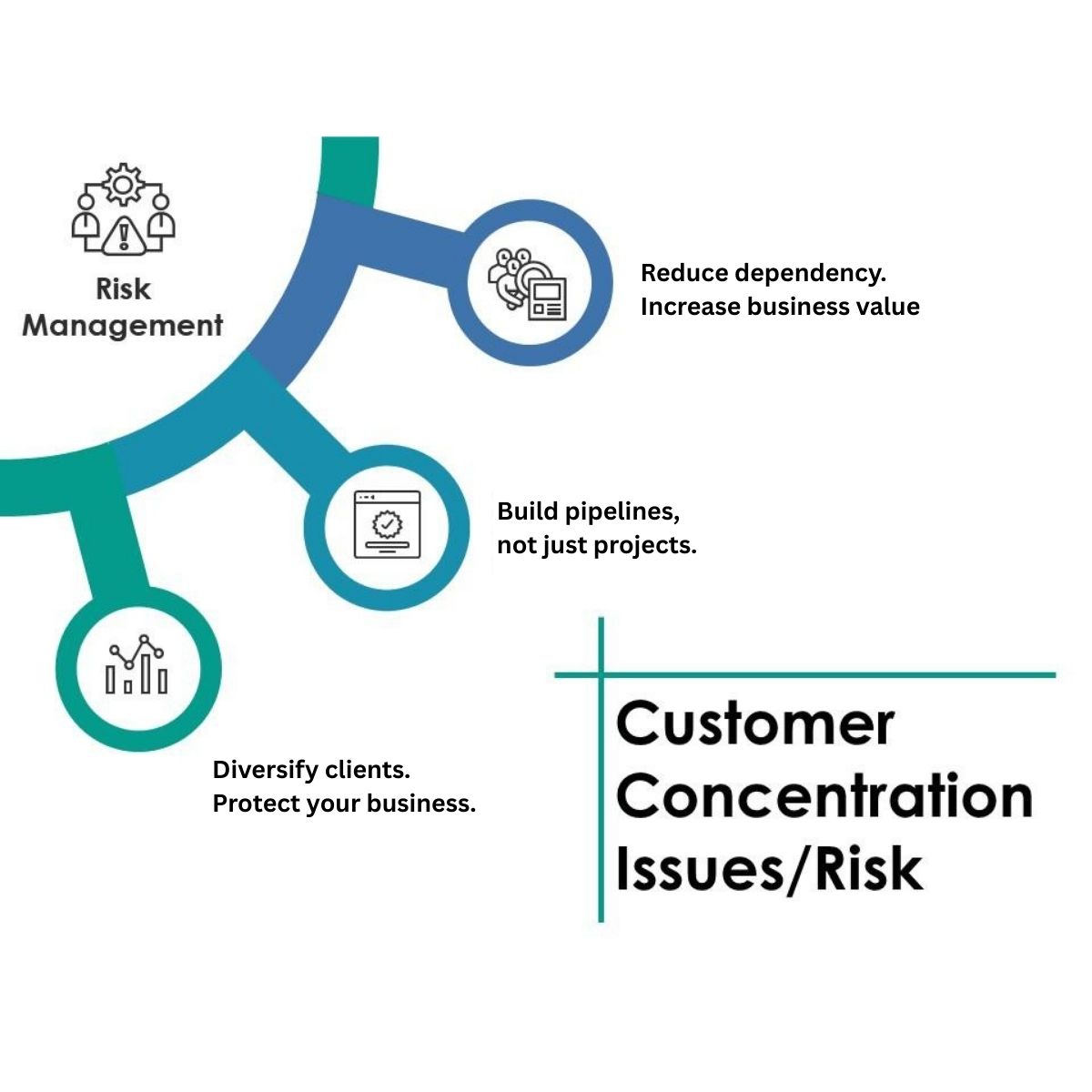
What Smart IT Founders Do to Avoid Client Concentration

Successful founders treat big clients as anchors, not lifeboats.

They actively reduce dependency by:

  • Building parallel sales pipelines
  • Creating industry-specific offerings
  • Saying no to unhealthy dependency
  • Documenting processes beyond one client’s needs

This approach feels slower in the short term but creates real stability.


Final Thought

One big US client can help an IT company grow faster. But depending on that client for survival is a long-term mistake.

Client Concentration doesn’t announce itself. It waits. And when it shows up, options are limited and damage is already done.

Strong IT businesses are built on balanced clients, steady systems, and founders who plan for freedom, not comfort.

That difference decides who survives the next downturn, and who doesn’t.


Image credits: Slide Team

For more articles on startup growth, fundraising strategies, and business insights for Indian founders, 
visit: Udyamee India Magazine

Share. Facebook Twitter Pinterest Bluesky Threads Tumblr Telegram Email
Udyamee India
Udyamee India

Related Posts

Root Cause Solutions: Stop Wasting Time on Problems That Keep Coming Back

February 16, 2026

FMEA: The Risk Tool That Stops Problems Before They Cost You Money

February 14, 2026

Process Clarity Unlocked: The Simple Tool That Transforms How Your Business Works

February 13, 2026
HIghlights

India 5000 Conference 2025

A Historic, Inspiring, and Power-Packed Celebration of India’s Achievers

Strategic Leadership

5 Reasons Why Department Leaders Are Failing

Gen-Z Stare Revolution

5 Bold Strategies to Transform Your Team

Franchise Ownership

Powerful Strategies to Succeed in a Competitive Market

Stay In Touch
  • Facebook
  • LinkedIn
  • YouTube
  • Instagram
Main Categories
  • Growth
  • Innovation
  • Startups
  • Finance
  • Events
  • Spotlight
  • HR & People
  • Udyamee Initiative
Udyamee Initiative
  • Udyamee Business Council
  • Udyamee Awards
Growth
  • Leadership
  • Marketing
  • Operations
  • Sales
  • Strategy
Innovation
  • Tech
  • Automation
  • Digital tools
Startups
  • Funding
  • Branding
  • Success stories
Finance
  • Money
  • Investors
  • Tax
  • Planning
Events
  • Awards
  • Summits
  • Networking
Spotlight
  • Featured founder
  • Influencer
  • Brand
HR & People
  • Hiring
  • Culture
  • Productivity
  • Workplace
Facebook Instagram LinkedIn
  • Growth
  • Innovation
  • Startups
  • Finance
  • Events
  • Spotlight
  • HR & People
  • Udyamee Initiative
© 2026 Udyamee. Made with ❤️ by PrimeWebx.com

Type above and press Enter to search. Press Esc to cancel.

Ad Blocker Enabled!
Ad Blocker Enabled!
Our website is made possible by displaying online advertisements to our visitors. Please support us by disabling your Ad Blocker.

Website security powered by MilesWeb